

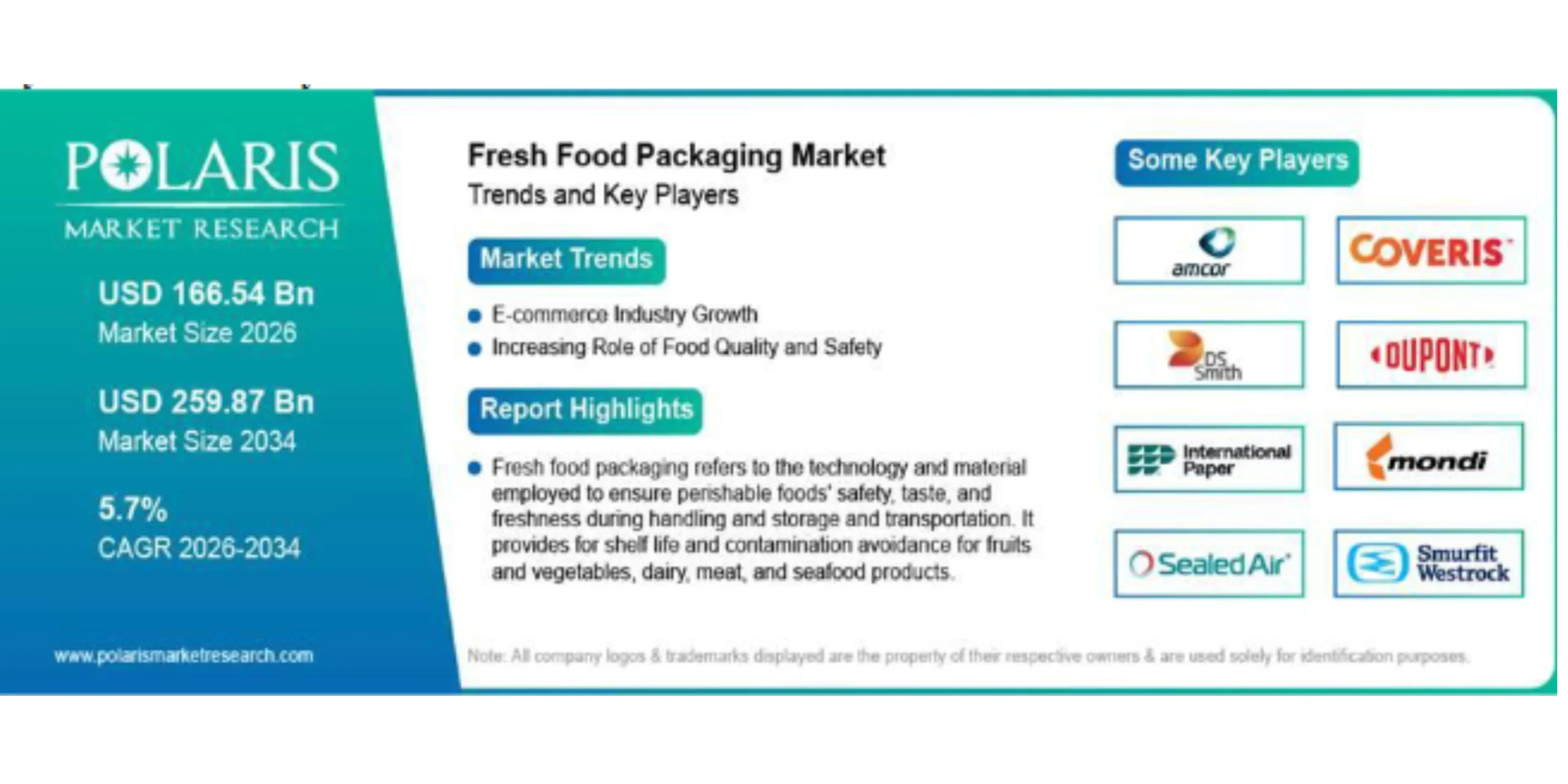
The global fresh food packaging market size was valued at USD 157.63 billion in 2025, growing at a CAGR of 5.7% from 2026 to 2034. Key factors driving demand for fresh food packaging include the rapid growth of e-commerce sector coupled with increasing focus on food safety and quality.
Fresh Food Packaging Market: Growth, Trends, Opportunities, and Future Outlook
The Fresh Food Packaging Market is expanding as food producers, retailers, distributors, and consumers place greater emphasis on food safety, freshness, convenience, and sustainable packaging. Fresh food packaging plays a critical role in protecting perishable products such as meat, seafood, fruits, vegetables, and other fresh foods during storage, transportation, and distribution while helping maintain quality and extend shelf life.
According to the latest market research, the global Fresh Food Packaging Market size was valued at USD 93.68 billion in 2024 and is projected to reach USD 139.52 billion by 2034, registering a CAGR of 4.1% from 2025 to 2034. The market is estimated at USD 97.41 billion in 2025, with Asia Pacific holding the largest market share in 2024.
Rising Demand for Safe and Fresh Food Packaging
Increasing consumer awareness regarding food quality and hygiene is one of the major factors supporting the Fresh Food Packaging Market growth. Fresh foods are highly susceptible to contamination, moisture loss, oxidation, and spoilage, creating a strong requirement for packaging solutions that can protect products throughout the supply chain.
Modern packaging technologies help maintain product integrity while reducing exposure to external contaminants. Effective packaging can also extend shelf life, allowing retailers and distributors to transport fresh products over longer distances while reducing product losses.
The growing consumption of fresh and minimally processed foods is further supporting demand. Consumers increasingly seek convenient food products that retain freshness while offering easy storage and handling.
E-Commerce Accelerates Packaging Requirements
The rapid expansion of e-commerce and online grocery shopping is creating significant opportunities for the fresh food packaging industry. Online food distribution requires packaging capable of protecting products during picking, handling, transportation, and last-mile delivery.
Fresh food packaging must withstand multiple stages of logistics while maintaining product quality. This has increased demand for durable, lightweight, leak-resistant, and temperature-compatible packaging solutions.
The development of cold-chain logistics is also important. As online grocery platforms expand their fresh-food offerings, packaging manufacturers are focusing on solutions that work effectively with refrigerated and controlled-temperature transportation systems.
Sustainability Becomes a Central Market Trend
Environmental concerns are transforming packaging development. Consumers, retailers, and food manufacturers are increasingly seeking packaging that reduces environmental impact without compromising food protection.
Growing adoption of recyclable, biodegradable, compostable, and paper-based packaging is creating new opportunities for manufacturers. Regulations aimed at reducing plastic waste are also encouraging companies to reconsider conventional packaging formats.
The paper segment is expected to expand at a rapid rate during the forecast period, supported by increasing adoption of recyclable materials. At the same time, manufacturers are working to improve the barrier properties of paper-based solutions so that they can provide adequate protection against moisture, oxygen, grease, and contamination.
Polyethylene Maintains a Strong Market Position
By material, the market includes polyethylene, polypropylene, paper, aluminum, and other materials. Polyethylene dominated the Fresh Food Packaging Market in 2024, supported by its durability, flexibility, cost-effectiveness, and broad range of applications.
Polyethylene packaging can provide useful barrier and moisture-resistance properties for various fresh food products. It is used across flexible packaging formats and other applications where protection and handling efficiency are important.
However, sustainability concerns are encouraging manufacturers to develop recyclable and lower-impact polyethylene solutions. Advances in material science are expected to help balance packaging performance with environmental requirements.
Meat Products Represent a Major Application
Fresh food packaging is widely used across meat products, vegetables, seafood, fruits, and other applications. The meat products segment held the largest share in 2024, reflecting the importance of hygienic, durable, and protective packaging for meat and related products.
Meat packaging must help protect products from contamination while supporting temperature-controlled distribution. Technologies such as modified-atmosphere packaging and vacuum packaging can help maintain product quality and extend shelf life.
Seafood packaging also presents significant opportunities because seafood products are highly perishable and require careful handling throughout the supply chain. Packaging innovations that improve moisture management, sealing, and transportation durability are therefore expected to gain importance.
Smart and Active Packaging Creates New Opportunities
The adoption of smart and active packaging technologies represents an important emerging opportunity in the Fresh Food Packaging Market. Active packaging can interact with the food environment to help maintain freshness, while smart packaging technologies can provide information about product conditions.
Sensors, indicators, freshness-monitoring technologies, and intelligent labeling can provide retailers and consumers with additional information regarding temperature exposure, product condition, and shelf life.
These technologies could help improve inventory management and reduce unnecessary food disposal. As digitalization spreads throughout food supply chains, intelligent packaging solutions are expected to become increasingly relevant.
Asia Pacific Leads the Market
Asia Pacific held the largest share of the global Fresh Food Packaging Market in 2024. The region benefits from expanding food-processing industries, growing urban populations, rising retail activity, and increasing investment in packaging manufacturing.
China and Japan are important contributors to regional development, supported by investments in advanced packaging manufacturing and food distribution infrastructure. India and other emerging Asian economies are also creating opportunities as urbanization, organized retail, e-commerce, and packaged fresh-food consumption increase.
North America is expected to experience strong growth during the forecast period, supported by innovations in green packaging and increasing demand for packaged fresh foods.
Market Challenges and Industry Considerations
Despite favorable growth prospects, the Fresh Food Packaging Market faces challenges related to fluctuations in raw material prices. Packaging manufacturers must manage changing costs for plastics, paper, aluminum, and other materials while maintaining competitive product pricing.
Sustainability requirements can also increase development and production costs. Companies must balance environmental objectives with essential requirements such as food safety, barrier performance, durability, recyclability, and shelf-life extension.
Another important challenge is the need to develop packaging solutions that perform effectively across increasingly complex cold-chain and e-commerce distribution networks.
Key Companies in the Fresh Food Packaging Market
The competitive landscape includes Amcor plc, Anchor Packaging LLC, Coveris, DS Smith Plc, DuPont, International Paper Company, Mondi Group, Sealed Air Corporation, Silgan Holdings Inc., Smurfit Kappa, TPN Food Packaging, and WestRock Company.
Market participants are focusing on recyclable materials, lightweight packaging, shelf-life extension technologies, smart packaging, and product innovations designed to meet changing food-industry and consumer requirements.
Conclusion
The Fresh Food Packaging Market is positioned for sustained expansion as food safety, convenience, e-commerce, sustainability, and shelf-life requirements continue to influence packaging demand. The market is projected to grow from USD 97.41 billion in 2025 to USD 139.52 billion by 2034, registering a 4.1% CAGR from 2025 to 2034.
Asia Pacific’s strong market position, increasing demand for sustainable materials, rapid growth of online food distribution, and advances in smart and active packaging are expected to create new opportunities across the industry. As food producers and retailers seek packaging that combines protection, efficiency, convenience, and environmental responsibility, innovative fresh food packaging solutions will remain an essential part of the global food supply chain.